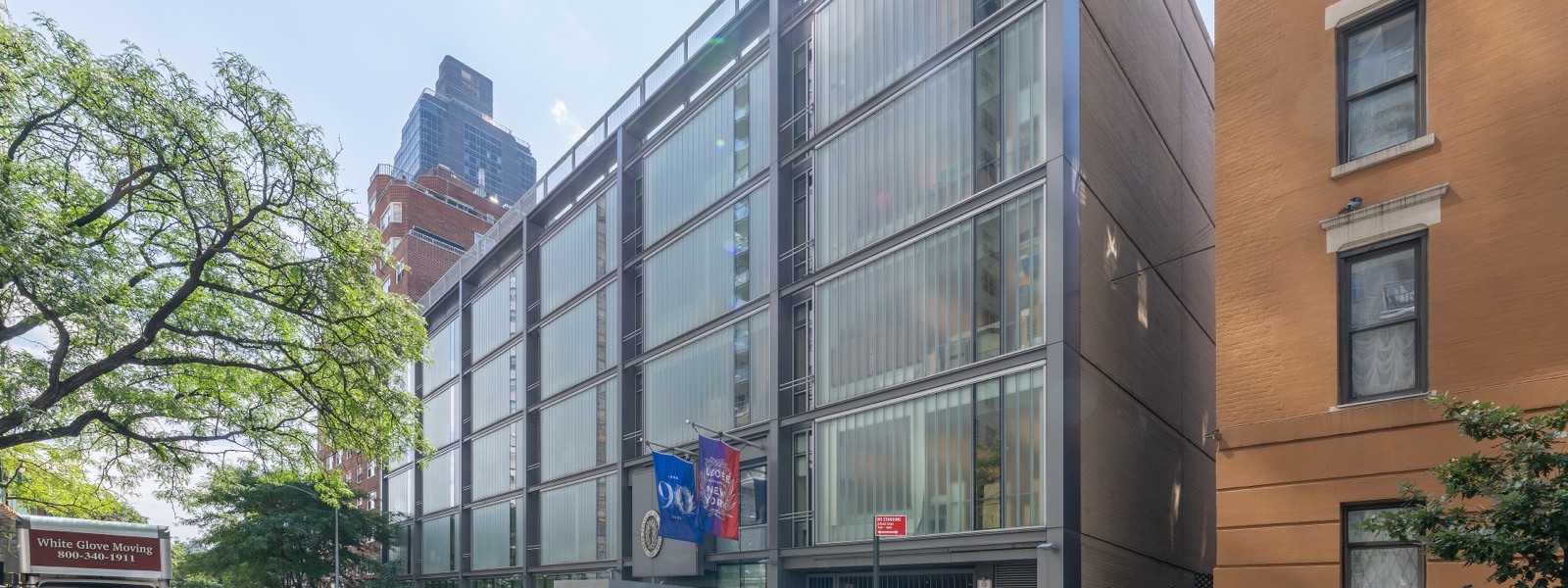
Your child attends the Lycee Francais de New York and is struggling in mathematics. You start looking for a tutor. You live in the city with arguably the highest concentration of private tutors on the planet : Manhattan is saturated with them. And yet, you cannot find anyone. Not because there are no math tutors in New York. But because virtually none of them understand French mathematics. This is a problem that hundreds of LFNY families face every year. And it is a problem we solve.
After guiding more than 1,100 students toward elite institutions, I can state this with certainty: the gap between French mathematics and American mathematics is not a question of level. It is a question of method, philosophy, and intellectual rigor. An American tutor, even an excellent one, cannot help a student in the French curriculum. They simply do not speak the same mathematical language.
The LFNY: an elite institution in a paradoxical environment
The Lycee Francais de New York is one of the most prestigious French schools abroad. Located on Manhattan's Upper East Side, it enrolls approximately 1,300 students from preschool through Terminale (12th grade). Tuition exceeds $40,000 per year. The families who enroll their children there are demanding, ambitious, and accustomed to excellence.
The LFNY follows the French national curriculum. Mathematics is taught according to French methodology: rigorous proofs, deductive reasoning, abstract formalism. Students sit for the French baccalaureate. And this is where the paradox emerges. These families live in New York, surrounded by an American educational ecosystem that operates on fundamentally different principles. When a student needs help, the natural reflex is to search locally. But locally, no one can help.
Why French math is incompatible with American tutoring
American mathematics and French mathematics share the same theorems, the same formulas, the same fundamental concepts. But the way they are taught, assessed, and conceptualized is radically different.
The American system is procedural and calculation-oriented. Students learn methods, apply them to standard exercises, and rely heavily on calculators. The SAT Math section (the American standardized test) is an exercise in rapid problem-solving where intuition and speed matter more than formal rigor. An American student who knows which formula to use at the right moment earns a high score.
The French system is deductive and proof-oriented. From middle school onward, students are expected to justify every step of their reasoning. By Seconde (10th grade), mathematical writing becomes a grading criterion in its own right. By Terminale, "prove that..." exercises represent a significant portion of the baccalaureate exam. A French student who finds the correct answer but cannot prove it loses points. An American student who finds the correct answer has completed the exercise.
This difference is fundamental. A tutor trained in the American system will teach your child how to find the answer. A tutor trained in the French system will teach your child how to construct a complete, structured, and irrefutable argument. These are two different intellectual exercises. And the French baccalaureate tests the second, not the first.
Pain points by level: from college to the bac
College (6eme - 3eme / grades 6-9)
This is where the first difficulties appear, often insidiously. The student seems to be keeping up, grades look acceptable, but the foundations of mathematical rigor are not being solidly laid. French geometry, with its formal proofs starting in 4eme (8th grade), comes as a shock for students who have not acquired the reflexes of mathematical writing. Literal calculus (manipulating algebraic expressions) is introduced earlier and more deeply than in American math. A student who falls behind in college accumulates gaps that explode in lycee.
Lycee (Seconde - Terminale / grades 10-12)
Lycee is where the gap becomes a chasm. Seconde introduces functions, vectors, and probability at a level of formalism that the American system often does not reach until university. In Premiere and Terminale, the mathematics specialization is formidably demanding: sequences, limits, continuity, differentiation, integration, combinatorics, conditional probability. Every concept comes with proof exercises that require total mastery of deductive reasoning.
LFNY students aiming for the mathematics specialization in Terminale, which is essential for French scientific preparatory classes or engineering schools, must maintain a level that very few New York tutors can support. Grading is severe. A 14/20 in mathematics at the LFNY represents a level that most American tutors could not even properly assess.
Physics and chemistry
The problem extends beyond mathematics. French-curriculum physics and chemistry are also vastly different from the American approach. French physics is deeply mathematized: Newton's laws, thermodynamics, and electromagnetism are taught with rigorous mathematical formalism. Exercises require proofs, literal calculations, and precision in expressing results (units, significant figures, dimensional analysis) that the American system does not practice to the same degree. Our tutors cover these subjects as well, with the same mastery of the French curriculum.
The online tutoring advantage: the timezone works in your favor
New York is six hours behind Paris (EST, UTC-5). Far from being an obstacle, this time difference actually creates an ideal window for online tutoring. A France-based tutor can give a lesson at 4 PM Paris time, which is 10 AM in New York, during a gap in the school schedule. Or a lesson at 8 PM Paris time corresponds to 2 PM in New York, right after LFNY dismissal.
Online tutoring eliminates the geographic constraint that makes academic support virtually impossible in New York for French-curriculum students. No more searching for a unicorn : a French-speaking tutor who masters the national curriculum, lives in Manhattan, and is available at the right times. Our tutors are based in France, trained in the French system, and specialize precisely in the difficulties that students at French schools abroad encounter.
The quality of online sessions matches that of in-person lessons. Shared screens, interactive whiteboards, real-time exercises: the student writes, the tutor corrects, the proof is built together. For mathematics, where the exchange revolves around equations and written reasoning, the online format is perfectly suited.
The dual ambition of LFNY families: Ivy League and French prepas
What makes the LFNY situation unique is the dual ambition. Many of these families are simultaneously considering the most selective American universities (Harvard, Columbia, Princeton, Yale) and elite French tracks: scientific preparatory classes, Sciences Po, HEC. This dual strategy is entirely viable, but it demands a level in French mathematics that tolerates no weakness.
For the Ivy League, French math grades are scrutinized by admissions officers who know the LFNY. A 15/20 in the mathematics specialization at LFNY is a strong signal of quantitative competence. But a 10/20 raises questions. For preparatory classes, Terminale transcripts are everything: math grades are the primary selection criterion. In both cases, solid mathematical support is not a luxury. It is a strategic necessity.
To understand how to build a competitive file for American universities, see our complete guide to Ivy League admissions. LFNY families have a structural advantage in this process, provided the academic level is beyond reproach.
The Carmine difference: strategic positioning for post-graduation
At Carmine, math tutoring is never disconnected from the overall strategy. We do not do "remedial work." We build an academic foundation that directly serves your child's post-graduation ambitions. Every lesson is a building block in a larger structure: the admissions file.
Our tutors know the French curriculum because they studied and taught within it. They know exactly what the baccalaureate examiner expects, how preparatory class applications are evaluated, and what American universities look for in a French mathematical profile. This is not generic tutoring. It is strategic academic support.
With 1,100+ students guided toward elite institutions, we have a comprehensive vision that standard tutors lack. We understand that your child's 14 in math during Premiere is not just a number on a transcript : it is a signal sent to Parcoursup, to preparatory class selection committees, and to admissions officers at Columbia or Princeton. Every point matters. Every mastered proof brings your child closer to their goal.
For French families in London facing the same challenges, discover our tutoring support for Lycee Charles de Gaulle students.