Contact

Math Tutoring for Franklin Students

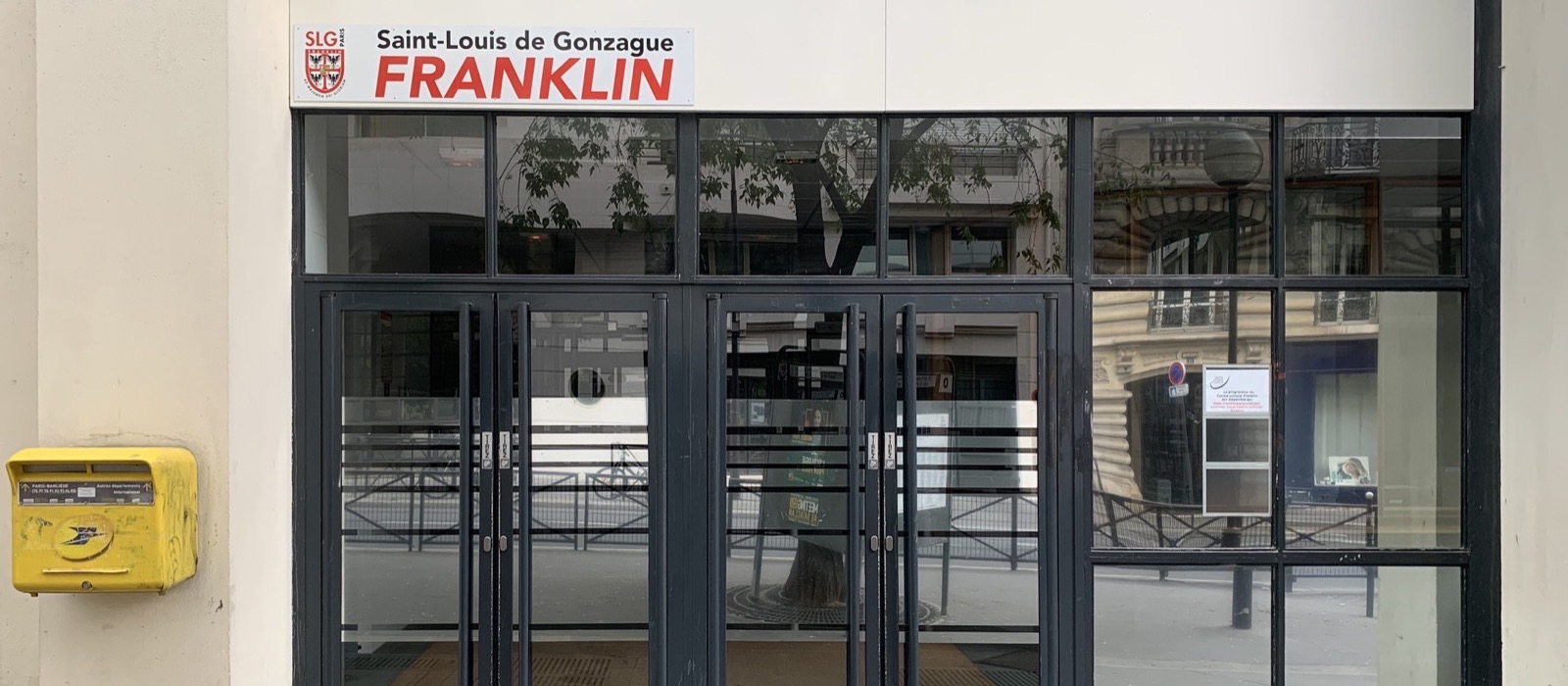
Franklin -- the Lycee International de Paris, housed within the Cite Scolaire Honore de Balzac in the 17th arrondissement -- holds a distinctive position in the Parisian educational ecosystem. It is a public school that offers high-level international sections, attracting students from expatriate and internationally mobile families seeking an anchor in the French system while maintaining a strong international dimension. But this hybrid positioning creates a precise challenge in mathematics: the program is entirely French, with all the rigor that implies, and students in international sections must conform to it without concession. A generic tutoring service, delivered by a tutor who understands neither this specific positioning nor the challenges it creates, is a waste of time and money.

With experience spanning over 1,600 students, including many from Franklin and other lycees with international sections, I know precisely where the friction points lie. The challenge is never a lack of talent. It is the gap between the mathematical habits the student has acquired in their prior education and what Franklin's French program demands every day.

What makes Franklin unique -- and demanding

Franklin is neither a classic French lycee nor an international school. It is a French public school with international sections -- in English, Arabic, Hebrew, Portuguese, Japanese, among others. Students follow the French curriculum in its entirety, with the addition of specific courses in their section language. Mathematics, physics-chemistry, history-geography, French -- all of this is taught in French, according to the national curriculum, without modification or accommodation for students in international sections.

This structure has direct implications for mathematics. A student in Franklin's English section follows exactly the same math program as a student in a standard French lycee in the 17th arrondissement. The same theorems, the same proofs, the same written assessments, the same standards for mathematical writing. The difference is that this student also manages the demands of their international section in parallel: literature courses in English, history in English, preparation for the specific BFI exams. The total workload is considerable, and mathematics, which requires regular and intensive practice, is often the first subject to suffer when time runs short.

The BFI (Baccalaureat Francais International) adds another layer of difficulty. BFI mathematics exams are more demanding than those of the standard bac, and the full suite of international section exams compounds an already dense program. Franklin students pursuing the BFI -- and this is the majority of those in international sections -- must excel in both dimensions: the French mathematics program and the specific demands of their section.

The specific difficulties of Franklin students

Franklin's student population is inherently diverse. Diplomat families, international organization executives, expatriates posted to Paris for a few years, binational families settled long-term. This diversity means students arrive at Franklin with highly varied mathematical backgrounds. Some come from the French system and feel at ease. Others arrive from American, British, or IB systems and face the same methodological shock as students arriving at Jeanine Manuel or Saint-Germain.

The methodological shock is the first challenge. French mathematics does not work like Anglo-Saxon mathematics. Where the American or British system asks students to find the right answer, the French system asks them to prove why the answer is correct. Where the IB system encourages exploration and investigation, the French system demands formalism and rigorous writing. A student who has always succeeded in math in an international system can find themselves failing at Franklin -- not because they do not understand math, but because they do not know how to express it in the French format. For an in-depth analysis of this gap, see our article on choosing between EJM, Franklin, and Saint-Germain for expatriate families.

The second challenge is managing the dual workload. Franklin students in international sections carry a significantly heavier workload than students at a standard French lycee. Section courses, foreign-language literature assignments, preparation for specific BFI exams -- all of this comes on top of the complete French program. Mathematics requires regular work to be mastered. A student who sacrifices their math practice to finish an English literature essay accumulates gaps that, after a few weeks, become difficult to close.

The third challenge is mathematical vocabulary. Franklin's international section students often think in their section language. In English, Portuguese, Japanese. French mathematics has a precise and dense vocabulary: "derivee," "primitive," "suite convergente," "demonstration par recurrence," "limite finie en l'infini." A student who knows the concepts but hesitates on the French vocabulary loses time on every exercise. This linguistic friction, invisible to parents and generic tutors, is a significant factor in underperformance.

The failure of generic tutoring

The 17th arrondissement is not short of math tutors. But virtually all of them are calibrated for students at standard French lycees. They do not understand the dual constraint of Franklin students -- a complete French program plus international section requirements. They cannot identify the specific methodological shock experienced by students from Anglo-Saxon systems. They do not measure the impact of bilingualism on mathematical performance.

A generic tutor will re-explain the math lesson and assign additional exercises. This is useful for a standard French student who needs reinforcement. It is insufficient for a Franklin student whose problem is methodological and linguistic before it is mathematical. What this student needs is a tutor who understands where they come from, what they can already do, and what specifically they are missing to succeed in the French format.

Physics and chemistry: an identical challenge

Difficulties in physics-chemistry at Franklin follow the same patterns as in mathematics. The physics-chemistry program is entirely French, with the same requirements for rigorous writing and formalism. A student from the English section who learned physics in a system where you "solve for x" without writing a complete scientific argument finds themselves penalized at Franklin, where every exercise demands a justified equation setup, a detailed resolution, and verification of the physical coherence of the result.

Chemistry amplifies these difficulties with its specific technical vocabulary. Organic nomenclature, redox equations, acid-base titrations -- all subjects where French vocabulary differs significantly from English vocabulary, and where a bilingual student must master both to perform in both contexts.

Carmine's tutors: specialized in the Franklin profile

At Carmine Admission, the tutors we select for Franklin students specialize in international profiles within the French system. They understand the specific reality of this school: the complete French program, the international sections, the dual workload, the BFI. They know how to work with bilingual students whose dominant language is not always French, and they know how to adapt their pedagogy to each profile.

Our tutors do not simply re-explain the lesson. They rework the student's mathematical methodology: proof writing, specific vocabulary, notation conventions, time management during assessments. They capitalize on the skills the student already has -- conceptual understanding, reasoning ability, computational fluency -- and fill what is missing: French formalism. This is precision work, tailored to each student's exact profile.

Sessions can be conducted online or in person in Paris. For Franklin students living in the 17th arrondissement or nearby areas, in-person sessions offer a focused and efficient working environment. Online sessions are a perfectly suited alternative for families who prefer flexibility or who live farther from the school.

The Carmine advantage: tutoring and orientation strategy

What distinguishes Carmine Admission from any other tutoring service is that our tutoring operates within a comprehensive orientation strategy. We do not give math lessons to "raise the average." We work to position the student on the trajectory that leads to their post-bac objectives.

A Franklin student targeting EPFL needs a strong mathematical profile in the French tradition. A student targeting a scientific preparatory class needs a level of proof writing and speed that exceeds simple bac preparation. A student targeting an American university needs optimal BFI grades and a scientific profile that is readable for an English-speaking admissions committee. We know these requirements. And this knowledge guides the work of our tutors.

For expatriate families weighing Franklin against other institutions, our article on comparing EJM, Franklin, and Saint-Germain offers a detailed comparative analysis. And for families already at Franklin, knowing that Carmine tutoring combines academic excellence with post-bac vision is the reason our students do not merely "keep up with the program" -- they master it.

To understand how we adapt our approach to other bilingual school profiles, see our article on math tutoring for Jeanine Manuel students.

At Franklin, math is in French for everyone. When an international student falls behind, it is not the math that needs to be retaught -- it is the method. And the method is our specialty.

← All articles

Your child is at Franklin and math is a problem?

Our tutors know Franklin's program and the challenges of international sections. Free diagnostic, sessions online or in person in Paris.

Book a Trial Lesson