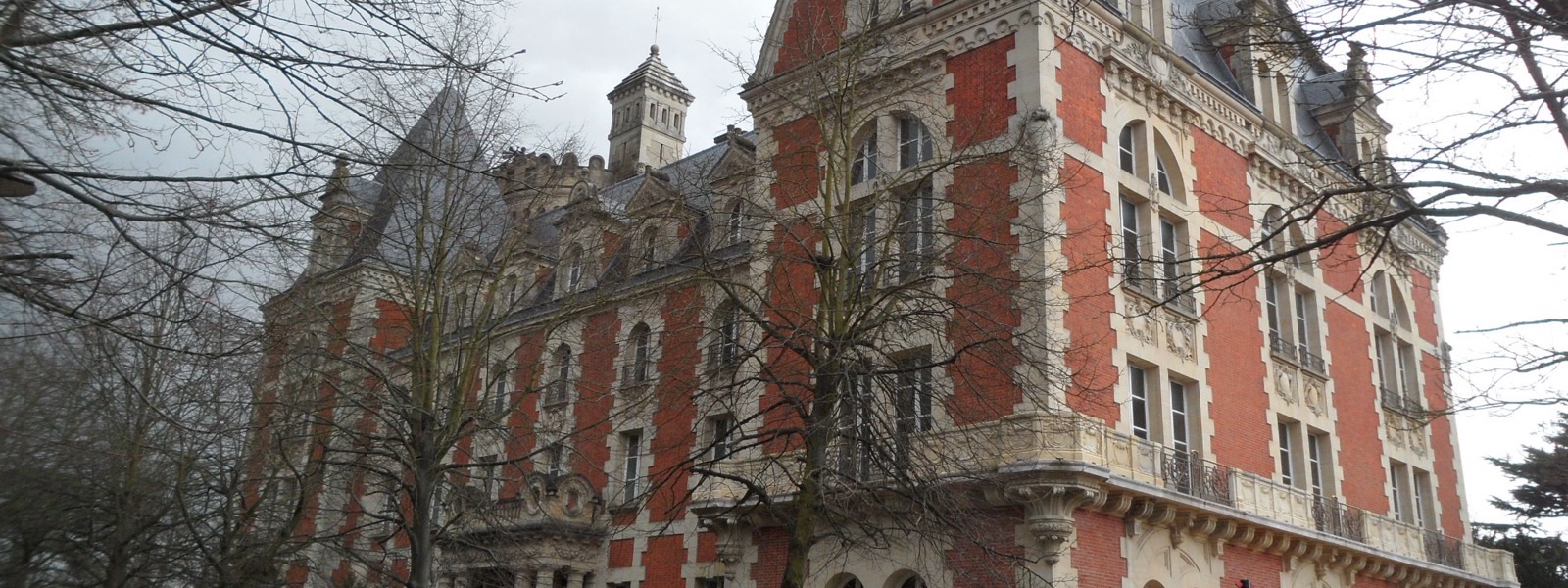
The Lycee International de Saint-Germain-en-Laye occupies a unique place in the French educational landscape. With fourteen national sections (American, British, German, Spanish, Japanese, and many others) it educates a student population of extraordinary diversity. But this diversity, which constitutes the school's cultural richness, creates a precise pedagogical challenge in mathematics: math classes are taught in French, for all students, regardless of their section. A student in the American or British section who thinks in English, who was trained in an Anglo-Saxon educational system, must master mathematics in their most rigorous form (the French form) in a language that is not always their dominant one. A generic tutor who does not understand this reality cannot help effectively.
Having worked with over 1,100 students, including many from the Lycee International de Saint-Germain, I understand this challenge from the inside. The issue is never a lack of ability. It is a gap between mathematical habits acquired in the student's original system and the demands of the French curriculum as taught at Saint-Germain.
What makes Saint-Germain's math program specific
The Lycee International de Saint-Germain-en-Laye follows the French national mathematics curriculum. There is no "lighter" version for students in international sections. A student in the American section follows exactly the same math program as a student in the French section. The same theorems, the same proofs, the same bac-style exercises, the same written assessments. The only difference is that this student must also manage the specific demands of their national section in parallel.
The BFI (Baccalaureat Francais International) reinforces this requirement. BFI mathematics exams are more rigorous than those of the standard baccalaureat. The international component of the diploma adds a significant workload (section exams, "connaissance du monde") on top of an already dense mathematics program. Students at the Lycee International do not do less math than anyone else. They do as much, with more constraints around it.
The size of the school also plays a role. The Lycee International is a large institution with significant class sizes. Individualized mathematics support is structurally limited. A student who falls behind in Seconde will not necessarily have the opportunity to catch up within the school framework. Time passes, chapters pile up, and gaps solidify. This is precisely where the intervention of a specialized tutor makes the difference.
The specific difficulties of international section students
The central challenge for students in Anglo-Saxon sections (American and British in particular) is the methodological shock with French mathematics. This shock is the same one experienced by students arriving at Jeannine Manuel from abroad, but it manifests differently at Saint-Germain because the student is already settled in France, often for several years, and those around them assume the language issue is resolved. It is not.
In French mathematics, the core of an exercise is not finding the right answer. It is demonstrating why the answer is correct. A structured proof with hypotheses, theorems cited by name, rigorous logical chaining, and a formal conclusion. A student trained in the American system, where the emphasis is on the result, where tests are often multiple-choice, where the graphing calculator is omnipresent, must fundamentally reprogram how they do mathematics. It is not enough to understand the concepts. They must express them in a format that is culturally French.
Students in the German section face a different but equally real challenge. The German system teaches mathematics rigorously, but the writing conventions differ from the French format. Notation, presentation of reasoning, the way properties are cited : all of this must be relearned in French conventions.
Students in the Spanish, Italian, or Portuguese sections generally fare better, as the mathematical traditions of Latin countries are closer to the French tradition. But even for them, the pace of the Lycee International and the demands of the BFI create areas of fragility, particularly in Terminale when workload peaks.
Another major challenge is managing bilingualism in a mathematical context. At Saint-Germain, students spend their days navigating between two languages. In mathematics, this navigation creates additional cognitive load. French mathematical vocabulary is dense and specific. A student who must mentally translate "remainder" to "reste," "derivative" to "derivee," "proof by contradiction" to "demonstration par l'absurde" loses a few seconds each time which, over a two-hour exam, translate into lost points.
Why generic tutoring fails at Saint-Germain
The tutoring market in the Yvelines is not short of math tutors. But virtually all of them work with the standard curriculum, for standard students, in standard schools. The Lycee International de Saint-Germain is not a standard school. A tutor who does not understand the specifics of the student population (the bilingualism, the methodological gap, the dual demands of the BFI) will not correctly diagnose the student's difficulties and therefore will not address them effectively.
A concrete example: a student in the American section making errors in analytic geometry. A generic tutor will redo the exercises, re-explain the formulas, assign practice. But the real problem, in most cases, is not that the student does not understand analytic geometry. It is that they do not know how to write a proof in analytic geometry in the French format. They arrive at the correct result but lose half the marks because their writing does not meet the expected conventions. A tutor who knows Saint-Germain recognizes immediately that it is the format, not the substance, that is the problem, and addresses it directly.
Physics and chemistry: the same challenge
Everything said about mathematics applies with equal force to physics and chemistry. The physics-chemistry program at the Lycee International follows the French curriculum, with its specific requirements for written reasoning, dimensional analysis, equation setup, and experimental rigor. A student from the British section who learned physics by "solving for x" without ever writing a complete physics argument will be penalized on assessments, not because they do not understand the physics, but because they do not express it in the expected format.
Chemistry raises specific vocabulary and convention issues. French organic nomenclature, redox equation writing, the presentation of reaction progress tables : all technical skills that cannot be improvised and require targeted instruction.
Carmine's tutors: specialized in the Saint-Germain profile
At Carmine Admission, the tutors we select for Lycee International students understand the unique context of this school. They know that math is taught in French for everyone. They know that students in Anglo-Saxon sections have a specific methodological deficit. They know that the BFI imposes additional rigor. And they know how to work with bilingual teenagers navigating between two educational cultures.
Our tutors do not simply re-explain the lesson. They rework the student's methodology from the ground up: how to approach an exercise, how to structure a proof, how to write a physics argument, how to manage time during an assessment. They use assessment formats typical of the Lycee International, not generic exercises. They prepare the student to succeed at their school, not at some imaginary one.
Sessions can be conducted online or in person. For families in Saint-Germain-en-Laye or surrounding areas, in-person sessions are available and often preferred. For families who value the flexibility of remote learning, online sessions deliver the same pedagogical rigor while eliminating commute time.
The Carmine advantage: tutoring in service of strategic orientation
The fundamental difference between Carmine and a standard tutoring service is that our tutoring is not an end in itself. It is an instrument serving a broader orientation strategy. We do not work to "raise the math average." We work to position the student where they need to be to reach their post-bac objectives.
A student at the Lycee International targeting EPFL needs a specific mathematical profile. A student targeting Sciences Po needs a different balance between subjects. A student targeting an American university needs BFI grades that are interpretable by an admissions committee that may not be familiar with the French system. We know all of this. And this knowledge directs the work of our tutors.
For families weighing the Lycee International against other institutions, our comparison between Jeannine Manuel and Saint-Germain provides a detailed analysis of the differences. And for a deep understanding of the mathematical gap that international students experience, our article on the math culture shock is essential reading.
At the Lycee International de Saint-Germain, math is in French for everyone. When the methodological gap compounds the linguistic challenge, only a tutor who understands both can help effectively.