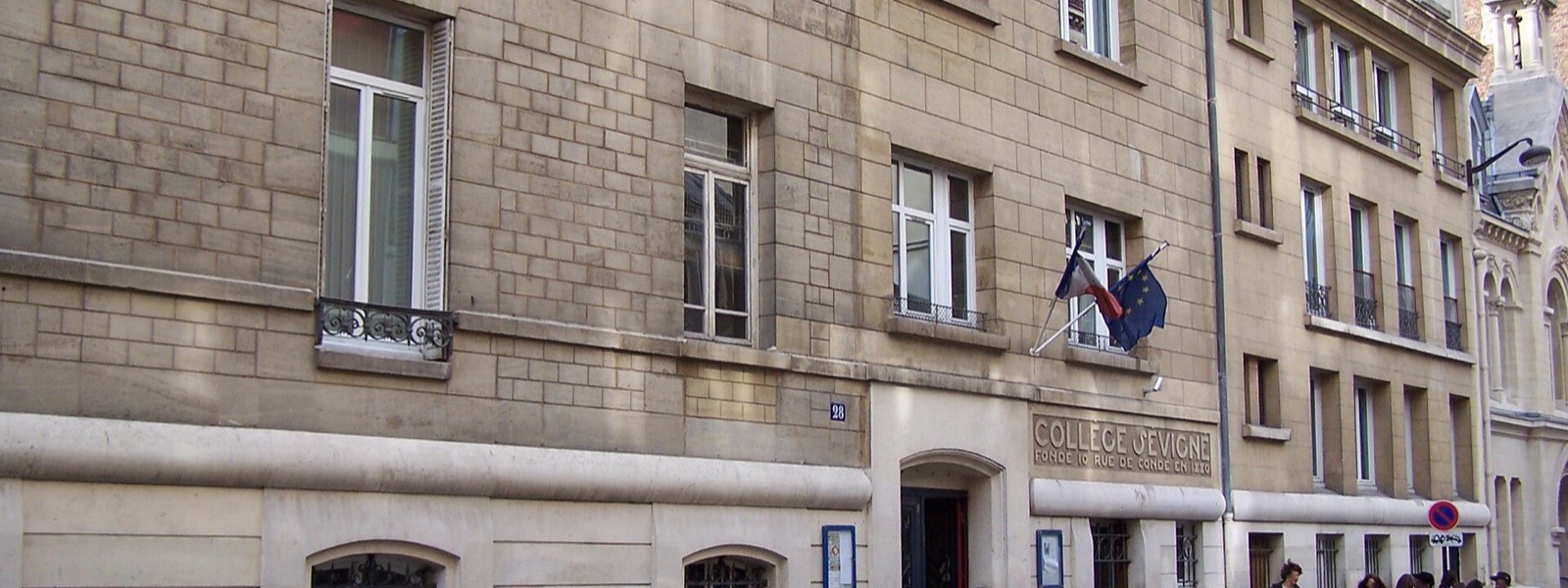
Of the leading Paris schools, Collège Sévigné runs the most structured admissions process. Applications open on a set date, tests are scheduled at a set time, and decisions are announced in fortnightly waves. Organised families will appreciate that. Everyone else should be careful, because each step has to happen in the right order.
First, the name, because it sends a lot of searches in the wrong direction. The school is Collège Sévigné, on rue Pierre-Nicole in the 5th arrondissement, and it takes children from nursery all the way to terminale (the final year of secondary school, age 17 to 18). There is no "Cours Sévigné" in Paris, and the Institution Sévigné is a different school altogether, in the Manche département in Normandy.
Two tracks from sixième, and the choice determines the test
At collège level (lower secondary, ages 11 to 15, running from sixième, the equivalent of Year 7 in the UK or 6th grade in the US, to troisième), Sévigné has three classes per year group and offers two tracks with extra English. Which one you pick is more than an administrative box on the form: it decides which tests your child will sit.
Bilingual English, Humanities, Sciences
- Only for pupils who had a bilingual education at primary school.
- Bilingual teaching in literature, history and science.
- Tests in maths, French and English.
- Decisions come out earlier than for the other track.
English +, Humanities, Sciences
- Open to all profiles.
- Extra English teaching from sixième to troisième.
- Tests in maths and French only.
- Pupils can move into the bilingual track from troisième onwards.
For a family whose child did not go to a bilingual primary school, this is good news: the English + track does not test English at entry. Selection is decided by maths and French.
Lycée: Monde or Europe
At lycée (upper secondary, ages 15 to 18), there are four classes per year group and two tracks. The Monde track prepares pupils for the French international baccalaureate (BFI) in every class. The Europe track steps up English from seconde (the first year of lycée, age 15 to 16); in première (age 16 to 17), pupils can either join the Monde track or continue in the European section, preparing for an IELTS certificate at B2 to C1 level.
To apply for the international section at lycée, the school also asks for an English questionnaire completed by the pupil's current English teacher. From troisième onwards, the family also fills in a questionnaire titled "Mieux vous connaître" (getting to know you better).
The calendar: a precise sequence
In the last published campaign, the pattern was as follows, and you can expect a similar calendar from one year to the next. Applications open in mid-October of the year before entry. Tests for sixième take place between December and February, on a Wednesday afternoon, by invitation. Decisions come out in waves: mid-February for the bilingual track, mid-March for the English + track, and mid-April for the other year groups.
- 13 October 2025Applications openFor sixième and for the other year groups.
- 3 December 2025 → 11 February 2026Six test dates for entry into sixième3 and 10 December, 14 and 28 January, 4 and 11 February, at 1.30 pm. After that, occasional extra tests.
- Mid-February 2026Decisions for the bilingual track
- Mid-March 2026Decisions for the English + track
- Mid-April 2026Decisions for the other year groupsCinquième, quatrième, troisième, première and terminale, subject to available places.
A practical point about these tests. The school calls them "indicative", yet they are the only tests in the whole procedure, and they cover the two subjects that do most to separate candidates. A child who reaches December of CM2 (the last year of primary school, age 10 to 11) with shaky foundations in arithmetic or problem solving has no time left to rebuild them. The foundations need checking at the start of CM2 in September, not the night before the test.
Children who do not live in the Paris region sit the tests at their current school, which receives them from Sévigné.
The application file
You apply online, giving details of both legal guardians. The application includes a letter of motivation from the parents, an online questionnaire, the previous year's bulletins (school reports), and then the current year's reports, which you send to the admissions office as soon as you receive them. The acknowledgement of receipt for the form must be returned signed by both legal guardians, on every page. The application fee is €120 per child, non-refundable.
The school warns that places are limited each year and that its pupils usually stay for their whole education. Outside sixième, places therefore come from pupils leaving.
Fees
Sévigné is a secular school sous contrat, meaning a private school under contract with the French state. The cost is made up of a basic tuition fee plus a supplement for the enhanced English track.
Where to start
Sévigné is the school where you know best what to expect: an opening date, tests on fixed dates, decisions in waves. If I had one minute to advise a family, I would say this. Choose the track first, since it determines the tests. Apply as soon as applications open in mid-October. And check your child's maths and French at the start of CM2, not in December.