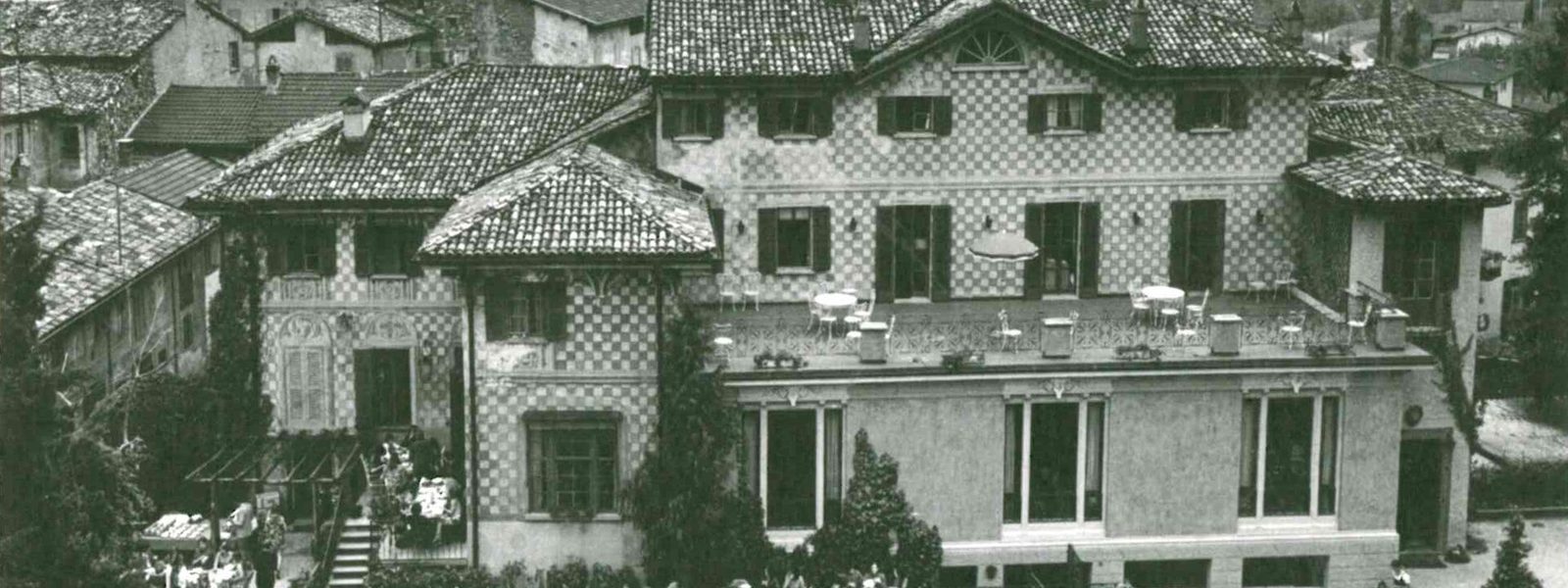
TASIS, The American School in Switzerland, sits in Montagnola on the Collina d'Oro, the hill just above Lugano in Ticino, the Italian-speaking south of the country. Mary Crist Fleming founded it in 1956, and it calls itself the oldest American boarding school in Europe. Twenty-five buildings stand around a seventeenth-century house, Villa De Nobili.
Families who come to it from a French or British school sometimes miss the obvious: this is an American high school in every structural sense, with credits, counselors and a high school diploma at the end. Most of what follows, starting with the price, comes from that.
What students graduate with
Every high school student works toward the TASIS diploma. It requires at least 19 credits, a civic literacy exam, service every semester and completion of the school's travel program, more on that below. On top of it, students add either the International Baccalaureate Diploma or Advanced Placement courses, from a list of eighteen that run when enough students sign up: Calculus AB and BC, Statistics, Physics C, Computer Science Principles, and also Art History and Music Theory.
IB can start early, with up to two Standard Level subjects in Grade 10, or in Grade 11 as usual. There is also a postgraduate year for students who start the IB late and need Grade 12 plus one more year to finish it.
There is no French baccalaureate and no A levels. The school itself writes that its diploma alone "is not sufficient" for most European public universities, which also expect strong IB or AP results. For a French student who might still want a prépa, the selective two-year classes that lead to the grandes écoles, the IB is the route to take; what each choice keeps open is set out in IB or French baccalaureate.
TASIS price per year, 2026-2027
The fee schedule is public, in Swiss francs, and unusually clear about what it covers.
| Item | 2026-2027 | Note |
|---|---|---|
| Boarding, middle and high school | CHF 106,500 | All-inclusive, Grade 6 to postgraduate |
| Day, Grades 9 to 12 | CHF 55,000 | Lunch included |
| Day, Grades 7 and 8 | CHF 49,000 | |
| Application fee | CHF 1,250 | Non-refundable |
| Enrollment deposit | CHF 3,000 | Due on acceptance, returned after graduation |
| Campus Enhancement Fund | CHF 5,000 | One-time, every new student from Grade 1 |
| Learning Resource Center | CHF 2,000 | High school students who need it; CHF 1,500 in middle school |
| Graduation fee | CHF 350 | Grade 12 only |
So a new high school boarder's first year comes to CHF 115,750 before personal spending. For comparison, Le Rosey's tuition is set at CHF 164,400 for 2027-2028: TASIS costs roughly two thirds of that, a year earlier.
The boarding fee includes housing, meals, laundry, basic health and accident insurance, textbooks, lab fees, after-school sport and activities, college counseling and the academic trips. It also includes English as an Additional Language. That matters more than it looks, because several Swiss boarding schools bill language support on top. What families still pay for, according to the 2026-2027 high school handbook: a laptop, which is compulsory; the uniform, bought from an outside supplier; AP exams, about CHF 140 each; the optional ski club, sold in packs of three, five or eight outings; and any trips beyond the number tuition covers.
Fees are paid in full by 1 July, in two installments (70% by 1 July, 30% by 15 November) or in four. Nothing is refunded for absence, withdrawal or dismissal: not tuition, not the deposit, not the fund.
How admission works
Applications go through the school's portal and there is no deadline. Admission is rolling, with one warning from the school: boarding places can run out. Students start in September, or in January if there is room. The usual entry points are Pre-K, Kindergarten, Grade 6 and Grade 9.
The committee reads transcripts, teacher recommendations and the student's interests, and usually answers within one to two weeks of a complete file. A visit is encouraged. For regular admission the school publishes no entrance test and no required English exam; placement tests happen at the start of the year, once the student is enrolled.
The file is therefore where the work goes. A French report card, with three-line teacher comments and averages out of 20 where 13 is a good mark, reads badly to an American committee unless someone explains it. Recommendations matter even more. French teachers are not used to writing a full page about a student, in English, with examples, and getting good ones takes time; recommendation letters from French teachers covers how, and an American boarding school expects the same thing a US university does.
TASIS acceptance rate
TASIS does not publish one. The 70% figure that turns up in searches comes from Boarding School Review, an American directory that gives no source. The same directory says 60% of students board, while the school reports around 290 boarders out of more than 750 students, under 40%. I would not lean on the 70%.
The real constraint is beds. In parent reviews on ExpatExchange, admission is described as "becoming more competitive" because the school is in demand. A file submitted early for Grade 9, when the school takes its largest intake, stands a much better chance than a June inquiry for Grade 11.
Scholarships and financial aid
The school gives financial aid based on need and merit, without publishing totals. It also runs a named award, the William E. Eichner Scholarship, which covers full tuition and boarding from Grade 10 to Grade 12. Flights, uniform, exam fees and pocket money are not covered; the school suggests about CHF 100 a week for the last. The file is demanding: transcripts, a recommendation from the head of school, two from teachers, one from a classmate, an English test for non-native speakers and a final interview. And one rule I have not seen elsewhere: application essays must be written without AI.
Example: the Eichner Scholarship for entry in 2027-2028.
The award is for students entering Grade 10 in September 2027. When we checked in October 2026, deadlines had not been announced and the school was not taking inquiries, so the scholarship page on the TASIS site is the one to watch.
Academic Travel
The program that sets TASIS apart is called Academic Travel, and graduation depends on it. From Grade 9 to Grade 11, every student goes on three trips a year. A "blue" trip tied to coursework, to Rome, Florence, Venice, CERN or British universities. A "green" one outdoors, in an Alpine hut, camping in the Cinque Terre, diving or sailing. And a "white" one on snow: Laax for seniors, Davos for younger students. The compulsory ski week goes back to the founding. Grade 12 has two trips. Alcohol is banned on all of them, even with written parental permission.
Daily life is more formal than many expect of an American school. The uniform means a navy blazer, a school tie and leather shoes, and phones go into a box at the door of every classroom. A former student interviewed by Gulf News remembered the dorm parents most, there "in good times and bad". Teacher reviews on International Schools Review describe a bubble, a campus where everything happens, with the trips as the main way out.
TASIS Switzerland and TASIS England
TASIS belongs to a not-for-profit foundation that also runs schools in Thorpe, Surrey, near London, in Dorado, Puerto Rico, and in Portugal. Each is a separate school with its own fees and its own admissions, so a decision in Montagnola says nothing about an application to Thorpe. For a family based in London, TASIS England is the sister school to look at: the same American culture, with a less alpine boarding life.
Which student it suits
The university results show who the school serves. The class of 2026 received 317 offers from 154 universities in 13 countries. On the 2022-2026 list the school publishes, US and Canadian universities dominate, Brown, Columbia, Yale, Chicago, Duke and Northwestern among them, followed by the UK (LSE, Imperial, UCL) and a few European schools such as St. Gallen, Bocconi and EHL. These are offers, not enrollments. Oxford, Cambridge, ETH Zurich and EPFL do not appear across those five years.
TASIS makes sense for a student aiming at American universities who wants to live that system from Grade 9: credits, AP courses, an assigned counselor from Grade 10, a file built over four years. I would send a student comfortable in English, solid but not necessarily outstanding across the board, who needs structure and close follow-up, before I would send a very strong young scientist aiming for EPFL or a French grande école, who will be better served by a school that keeps the French curriculum or by a very demanding IB program. How US admissions work is laid out in US universities with a French baccalaureate, and how TASIS compares on price with the other Swiss boarding schools in Swiss boarding school fees.
Choosing a boarding school deserves the same care as a university application: which school for this particular child, which entry year, which file, and how to present a French school record to an American committee. That is the work we do at Carmine with around twenty families a year; our school admissions page describes it.