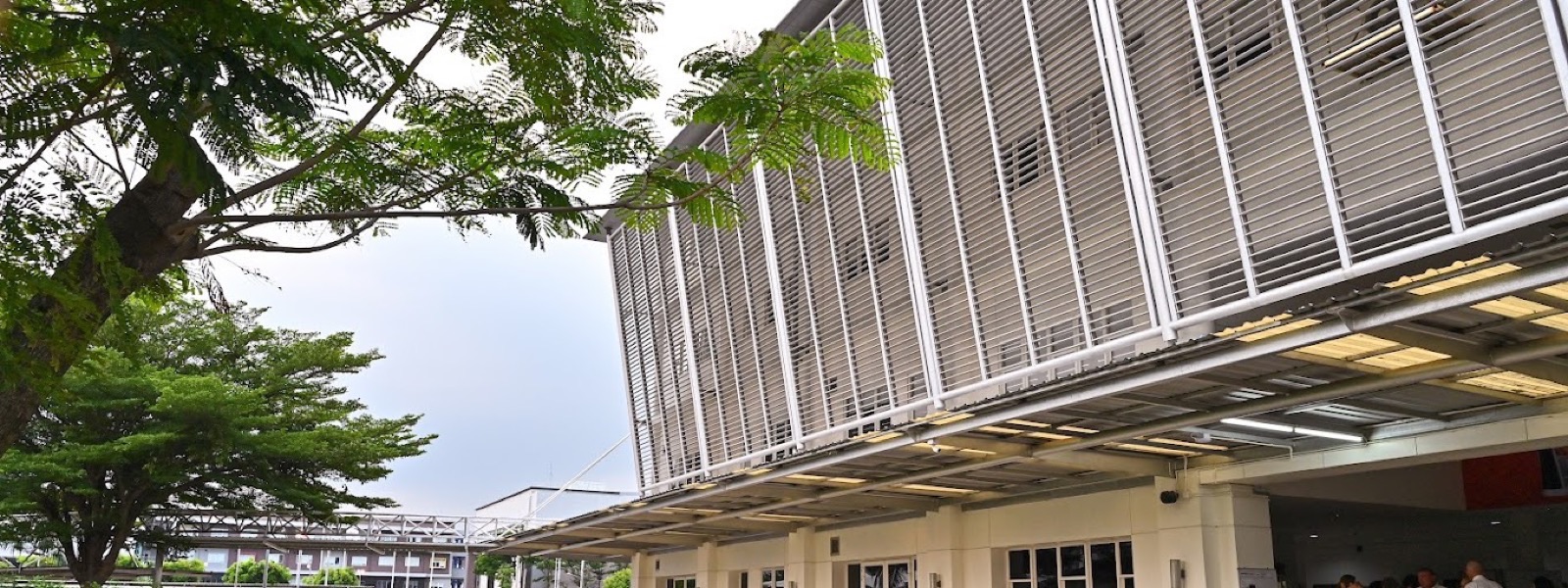
For a family moving to Bangkok with a child in collège or lycée (the French lower and upper secondary schools, roughly ages 11 to 18), there is hardly a choice to make. The Lycée Français International de Bangkok, the LFIB, is the only school in the city homologué, that is accredited by the French Ministry of Education, that runs from maternelle (nursery) all the way to the baccalauréat, the French school-leaving exam. The other accredited French schools in Bangkok, La Petite École and the Acacia schools, are nursery schools. From CP, the first year of primary, and even more so in collège, it is the LFIB or leaving the French system.
The questions families ask me are therefore about something else: which track to enter, at what cost, and at what level. What follows comes from the documents the school has published for the 2026-2027 school year.
The school in a few figures
Founded in 1957 as a small embassy school, it became a lycée in 1992 and moved in 2003 to its site at Pracha Uthit, in the east of the city. Today it has around 1,030 pupils of more than forty nationalities. It has an agreement with the AEFE, the French government agency that runs the network of French schools abroad, and is recognised as an international school by the Thai Ministry of Education.
The school is also very active on social media, Facebook and Instagram above all: it is the simplest way for a family to get a sense of school life before even arriving.
Where its graduates go
The school states that around two out of three graduates continue their studies in France. Its list of destinations from 2020 to 2025 gives a fairly precise idea of the level its students leave with: Polytechnique, Sciences Po, including the Sciences Po and Columbia dual degree, ESCP, EDHEC, classes préparatoires (the two-year courses that prepare for the grandes écoles entrance exams) such as Henri-IV, Saint-Louis, Janson-de-Sailly or Sainte-Geneviève, and the PASS first-year medicine programmes in Lyon, at Sorbonne Université, in Bordeaux and in Montpellier.
Abroad, the list includes EPFL, Bocconi, University College London, Warwick, McGill, Columbia and NYU, and in Thailand, Chulalongkorn and Mahidol. The school also says it supports applications to Oxford and Cambridge, thanks to its British teachers.
Reinforced English: two tracks, two sets of requirements
This is the point international families care about most, and the one where precision matters. The LFIB offers two ways of strengthening English in collège and lycée, with very different entry conditions.
British international section, then the BFI
- From 6e to seconde (ages 11 to 15), then the baccalauréat français international in première and terminale, the last two years of lycée.
- 4 hours a week of English language and literature, and 2 hours of history and geography in English.
- Admission by written and oral tests, and a decision by a section committee.
- Supplement of 22,000 baht a year, about €580.
Reinforced English and European section
- In collège, an optional course in European languages and cultures taught in English. In lycée, a European section, with one subject taught in English.
- Admission on the basis of a cover letter in English and the opinion of the class council.
- For a pupil who was already following it at their previous school, automatic entry, subject to places.
The levels required to enter the international section rise quickly with the year group. For a pupil who was not in it the previous year, the school asks for level B1 in writing and speaking to enter 5e or 4e (ages 12 and 13), B1+ in 3e, and B2 in seconde as in première BFI. 4e is often the right moment: the level required is still that of a good pupil who has practised English, and there are two years of collège left to settle into the section before lycée.
Before applying, you need to know these rules:
- Entry is only at the start of the year. A pupil who arrives during the year can only join the section if they were already following it at their previous school.
- New pupils take the tests in the first week of September, and join the section by the start of the third week at the latest.
- Terminale BFI is reserved for pupils who were in première BFI. There is no direct entry into terminale.
Registration
The LFIB takes new pupils at the September start of the school year, but also throughout the year. The application includes the requested documents, an academic test and an application fee of 5,000 baht, non-refundable. Registration is final once the file is complete and payment has been received.
The school does not publish the content of its academic test. For a pupil arriving from an English-speaking international school, the gap with the French curriculum is above all in mathematics, where method counts as much as level: writing out a justification, calculating without a calculator, handling proof in geometry. That is where the foundations need checking before entry, not after the first term.
The real cost
The LFIB charges two sets of fees depending on the pupil's nationality: one for French, Thai and European Union pupils, and another, 20 to 26% higher depending on the year group, for all other nationalities.
On top of tuition come:
- The first registration fee, 150,000 baht, about €3,980, paid only once for the child's whole time at the school. It must be paid before the pupil starts and is no longer refundable from the first day of class.
- The canteen, compulsory up to 3e: 24,540 baht a year in secondary, about €650. It is optional in lycée.
- The international section or the BFI, 22,000 baht a year, about €580.
- The school bus, if you need it: allow about €2,500 per child per year. The service is run by a private operator, Montri, and the price depends on where you live: from 77,788 to 110,572 baht a year, or about €2,060 to €2,930, plus a fuel surcharge revised every quarter.
To give an idea: a French pupil entering 4e in the international section pays about 569,700 baht in the first year, close to €15,100, entry fee included. With the bus, the figure approaches €17,500. In the following years, without the entry fee or the application fee, the bill comes down by about €4,100.
Payment is made in one instalment before 15 October, or in three: 40% on 15 October, 30% on 15 December and 30% on 15 March. Siblings get a 10% reduction for the second child and 15% from the third, on tuition and the entry fee.
Bursaries
French families on the consular register (the list of French nationals living abroad kept by the consulate) can apply for a French state school bursary, processed by the embassy. It can cover tuition, the international section, the canteen and the bus, provided the family uses the operator approved by the school. The first round closes in early February; a second committee meets in the autumn for newly arrived families.
For a family arriving in Bangkok
In Bangkok, the LFIB is the only accredited French school beyond nursery level, and therefore the only French route to the baccalauréat. It has solid results and good university destinations, two sets of fees depending on nationality, and a demanding English track that needs preparing for. For a family arriving in the city, the two decisions that matter are the English track, aiming for 4e at the latest for the international section, and the child's level in mathematics at the time of the entrance test. If your child is coming from an international school, that is where to start.