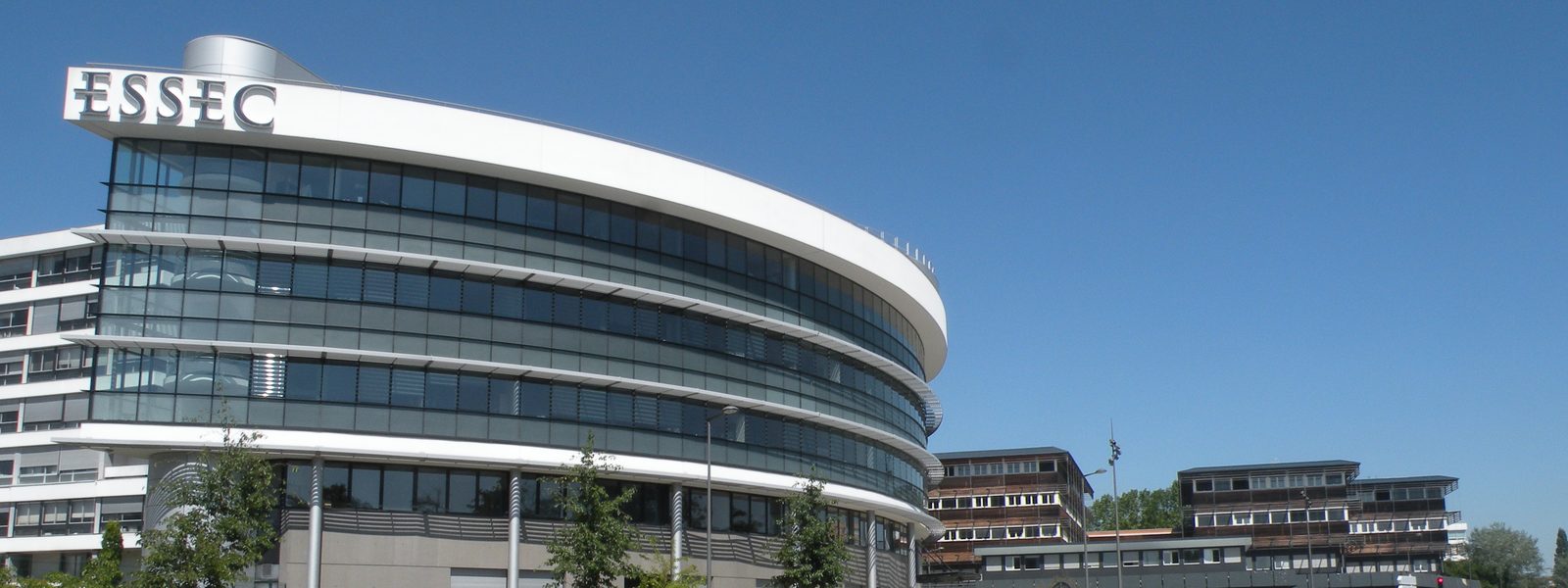
The SESAME exam is the entrance route, straight after the baccalauréat, into thirteen French business and management schools and fifteen programmes: four-year bachelors, including the ESSEC Global BBA, and five-year Grande École programmes. Many families see it as a general-knowledge multiple-choice test taken one Wednesday in April, between two bac revision sessions.
The rules and the weighting table, published every year by SESAME, tell a different story. The exam starts in Première (Year 12), every school counts the tests its own way, and the written test day follows rules that catch out anyone who has not read them.
One application, one day, thirteen schools
SESAME is a shared test bank: the written tests are common to all schools, then each school applies its own weightings and runs its own interviews. Registration goes through Parcoursup, where "Concours SESAME" counts as a single choice, with the schools listed under it. The fee is the same whatever the number of programmes chosen.
The first consequence: there is no reason to stop at two schools. The same marks are used everywhere, and adding a programme costs nothing.
The exam starts in Première: the school-record mark
Alongside the written tests, every candidate receives a mark for their school record, calculated from Première grades, the first two terms of Terminale, the early bac exams in French and now in mathematics, and the "fiche Avenir" filled in by the school.
Its weight is surprising. For the ESSEC Global BBA and the emlyon Global BBA, the school record carries a coefficient of 25, more than any written test. For the NEOMA Global BBA it carries 20. A student who let Première slide arrives at the exam with a gap that even the best day in April will not fully close. In other programmes the record only counts as a bonus: only the points above 10 are kept.
Read the weighting table before choosing schools
It is the most useful document in the whole process, and the least read. The tests are the same for everyone, but the schools are not looking for the same profile, and their weightings say so plainly:
- the ESSEC Global BBA gives mathematics a coefficient of 14, the highest of any programme;
- ESCE weights English at 20, the NEOMA Global BBA at 15;
- NEOMA's TEMA programme weights digital skills at 15;
- at EDC, EM Normandie and Paris School of Business the interview carries 50, against 15 at emlyon.
A student who is strong in maths should aim for ESSEC. A bilingual student, as many students at French schools abroad are, gains a clear advantage at schools that weight English heavily. A student whose written work is average but who speaks well will win their place at the schools where the interview counts most.
The table also lists eliminating marks: a zero in any written test rules a candidate out of KEDGE's International BBA, and several English-taught tracks eliminate anyone below 10 in English. Better to know before registering.
Test day: seven tests, at home, with no scrap paper
The written tests take place on a single day, at home, on a computer, proctored by webcam and microphone. There is no resit: missing the day means elimination. Three sequences follow one another: digital skills, current affairs and mathematics; then French, English and a second language; then a two-hour document analysis. Every question is multiple choice.
Four rules change how to prepare.
A wrong answer costs no more than a blank: both score zero. A question should never be left empty.
There is no going back. Except in the document analysis, a saved answer is final, and the next question only appears afterwards. A hard question cannot be kept for the end: the candidate has to decide, answer and move on.
No scrap paper, no pen, no personal calculator. The rules ban anything on the desk; in mathematics only the calculator built into the platform is allowed. Twenty problems in forty minutes without writing a single calculation on paper takes practice, and it is where a good student loses the most points through lack of habit.
Current affairs cover the ten months before the test. For a test in early April, that goes back to June of the Première year. Following the news every week from the summer works better than cramming it in March.
Before the written tests, a compulsory two-hour practice session must be completed on the same computer as on the day. Without it, no invitation to sit the tests.
The interviews: where the ranking is decided
Shortlisted candidates then sit each school's oral, around thirty minutes: an individual interview or a school-specific exercise, often with an interview in a foreign language. Slots are booked on the candidate portal, first come first served, so candidates should log in the day booking opens. A student living abroad can, depending on the school, take the interviews remotely.
With weightings of up to 50, the interview is not a formality. The panel expects a plan, precise knowledge of the programme, and the ability to think aloud about an unexpected question. French lycées do little to prepare for it.
From a French school abroad
A student taking the French baccalauréat, even abroad, must sit the exam through Parcoursup: direct application to the schools ("admission sur titre") is closed to them. A student taking a foreign diploma or the IB can choose between the exam, if their French is strong enough, and a direct application to each school, except EM Normandie, which only admits first-year students through SESAME. Both routes cannot be used for the same school.
For families weighing these programmes against a more international bachelor, I compared two of the most sought-after in the HEC-Bocconi and ESSEC-CentraleSupélec bachelors.
Where to start
With a student aiming for SESAME, I start by setting the weighting table next to their report cards: together they show which schools are worth applying to and where the points must be won. We then prepare what weighs most for that student, usually maths without scrap paper and the interview.
At Carmine, we build that strategy with the family, from the choice of schools to interview preparation. For the overall timeline, see when to start preparing university admissions.
SESAME 2027. According to the official exam website: thirteen schools and fifteen programmes; registration on Parcoursup from mid-January to mid-March 2027; written tests on Wednesday 7 April 2027; interview booking from 22 April; interviews from 24 April to 15 May 2027. Fee: €315, halved for students on a French state grant. The weightings quoted are from the table published for 2027; the test-day rules (scrap paper, calculator, no going back) and the maximum number of attempts, two for the ESSEC Global BBA and the emlyon Global BBA, come from the 2026 rules and should be checked against the 2027 edition.