For a student in the last two years of a French lycée who takes the maths specialism (the advanced maths course of the French baccalauréat), the SAT Math section contains almost nothing new. That is the trap. Families conclude there is nothing to prepare, the student arrives on test day with the level of a 16 out of 20 average, and comes out with a score that does not look like them.
I described the SAT as a whole in Taking the SAT from France. Here I only discuss maths: what the section contains, where a French student loses points, and how I prepare them.
SAT Math: format and duration
The Math section of the digital SAT has 44 questions, in two modules of 22 questions and 35 minutes each, a little over a minute and a half per question. The second module adapts to the first: it is harder or easier depending on the results in the first, so a student aiming for a high score has to get the first module almost entirely right. In each module, two questions are being trialled for future tests and do not count, without the student knowing which.
About three questions in four are four-option multiple choice. The others require the student to enter the answer. A graphing calculator is built into the testing app for the whole section, and students may also bring their own if it is approved. A formula sheet is available on screen. The section is scored from 200 to 800.
SAT Math by topic, and where it sits in the French syllabus
| SAT domain | Share | What it covers | Where it is taught in France |
|---|---|---|---|
| Algebra | ≈ 35% | Linear equations and inequalities, linear functions, systems | Ages 14 to 16 |
| Advanced Math | ≈ 35% | Quadratics, exponentials, polynomials, rational and radical functions | Age 15 to 16, then the first year of the maths specialism |
| Problem-Solving and Data Analysis | ≈ 15% | Ratios, percentages, units, statistics, probability, margin of error | Only in part: statistical inference is not in the French syllabus |
| Geometry and Trigonometry | ≈ 15% | Area and volume, triangles, circles, right-triangle trigonometry, radians | Middle school through the penultimate year |
No derivatives, no integrals, no sequences, no complex numbers. A good student in the maths specialism has seen it all, often two or three years earlier. The one real gap is American-style statistics: margin of error, the difference between an observational study and an experiment, what can be concluded from a sample.
Where a French student loses points on SAT Math
Reading in English. Questions are often real-world situations of four or five lines: a phone plan, a growing population, a ticket price. Half the work is translating the situation into an equation. A student used to the terse statements of French maths loses time here, and time is what runs out first.
Vocabulary. Slope, y-intercept, vertex, zeros, percent increase, median, standard deviation: the French student knows every concept under another name. Nothing is hard, but each word that causes a hesitation costs a few seconds, and forty-four questions later those seconds are missing.
Writing numbers. For entered answers, the official directions reject commas: a student who types 3,5, the French way, instead of 3.5 loses the question even though they had found the answer. Fractions too long for the box are entered as decimals, mixed numbers as improper fractions or decimals. US units, inches, feet, miles, pounds, also appear in questions.
Pace. In France, a good student is rewarded for rigour on a long exercise. On the SAT, you have to move fast through easy questions and keep time for the last, hardest ones. That reflex has to be built, and it only comes with timed full-length practice tests.
SAT Math and the calculator: learn it before test day
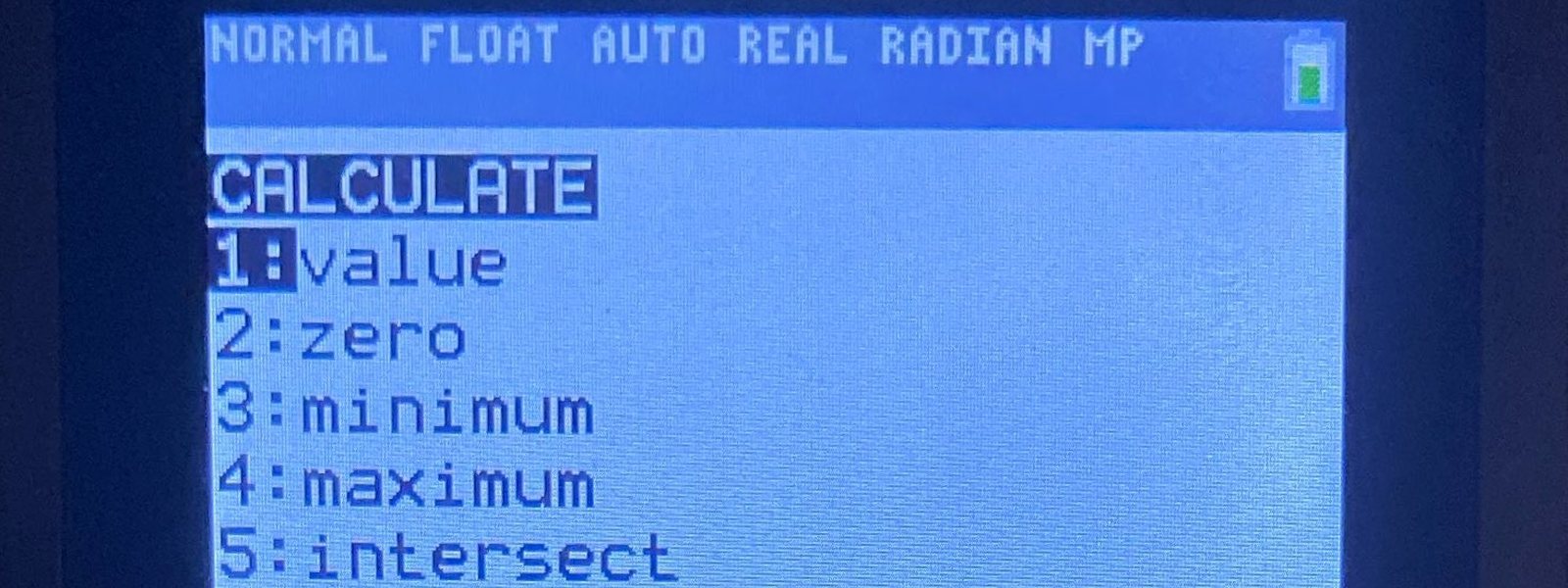
The built-in graphing calculator can plot a curve, read off an intersection, solve a system in seconds. Used methodically, it saves several minutes per module. But the student needs to have handled it beforehand: test day is not the moment to discover the tool. I have my students work with it from the first session, alongside calculation by hand.
What maths score to aim for, and how to prepare
For a student in the maths specialism aiming at a selective university, the maths score should be their strength: it is the section where a French lycée student can get close to the maximum, and it offsets a Reading and Writing section that is often harder for them. Effective preparation has four stages: one full practice test to place the student, vocabulary and answer-entry conventions, practice by domain on weak points, then timed practice tests until the real one.
We built Summit, our digital SAT practice platform, for exactly this: full practice tests in test conditions, practice by domain, a detailed score report. Access is free, along with our other free tools. And for a student who wants to aim for the top of the scale, I prepare them in private lessons, tying the SAT to the rest of their application with Carmine: dates, choice of universities, the file.