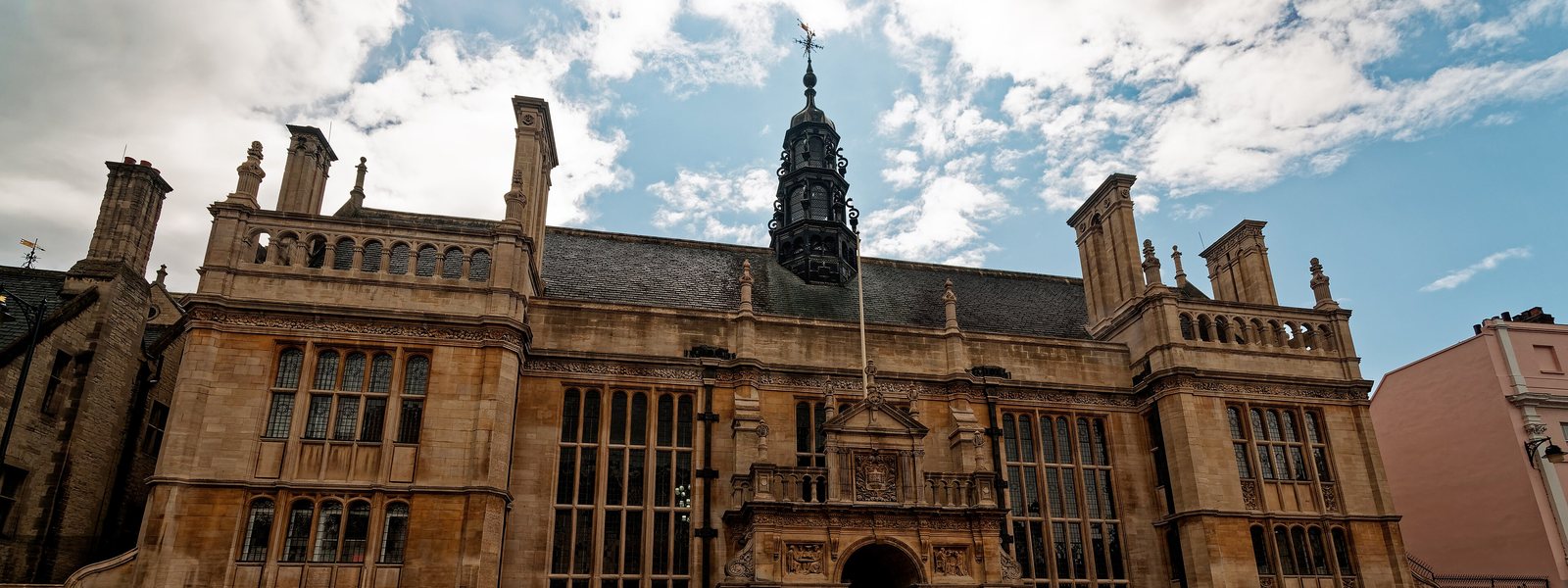
A student from a French lycée applying to Oxford or Cambridge soon finds that the French baccalauréat alone does not separate candidates. For most courses there is a written admissions test, taken in October of the final year of school, before the student even knows whether they will be invited to interview. The test carries a lot of weight: it often decides what happens next.
The landscape changed in 2026. Oxford, which used to set its own papers, now uses the tests of UAT-UK, the joint body of Cambridge and Imperial College. For families, this is a simplification: a student aiming for Oxford and Cambridge in the same subject, or Cambridge and Imperial, takes the test only once. For 2027 entry, these tests are also used, depending on the course, by Imperial, LSE, UCL, Warwick and Durham.
Which test for which course
| Test | At Oxford | At Cambridge |
|---|---|---|
| TMUA (mathematics) | Mathematics, Mathematics and Statistics, Mathematics and Computer Science, Mathematics and Philosophy, Computer Science, Computer Science and Philosophy | Mathematics, Computer Science, Economics |
| ESAT (science and engineering) | Physics, Physics and Philosophy, Engineering Science, Biomedical Sciences | Engineering, Natural Sciences, Chemical Engineering and Biotechnology, Veterinary Medicine |
| TARA (reasoning) | PPE, Economics and Management, Psychology, Human Sciences, History and Economics, History and Politics | Not used |
| LNAT | Law | Law |
| UCAT | Medicine | Medicine |
For Cambridge's other courses, in the humanities, languages and social sciences, there is no test to book in advance: the college that invites the student to interview sets its own written assessment, or none. In Computer Science, two Cambridge colleges, Peterhouse and Trinity, add their own test to the TMUA. These lists change from year to year: check them on the course page.
How the tests work
They are taken on computer at an approved test centre: a student living in France sits them in France, without travelling to the UK. Registration happens in two steps, creating an account at the start of summer, then booking a date from late July, and it closes at the end of September. Outside the UK and Ireland, each test costs £133.
The TMUA lasts two and a half hours, in two papers of twenty multiple-choice questions, without a calculator. The ESAT is made of forty-minute modules of twenty-seven questions: everyone takes the core maths module, and most candidates two more depending on the course, from physics, chemistry, biology and a second maths module. Results are reported on a scale from 1 to 9, with no pass mark. Cambridge warns that almost no one gets full marks and that some strong candidates do not finish the paper.
Example: the calendar for 2027 entry. Account creation from 1 June 2026, booking from 20 July to 28 September 2026, tests from 12 to 16 October 2026, results on 16 November. The UCAS application for Oxford and Cambridge had to be sent by 15 October. Oxford held its online interviews in December and gives its decisions on 12 January 2027. The January 2027 sitting does not apply to standard Oxford and Cambridge applicants.
What these tests change for a French student
The tests follow the British curriculum. The TMUA, for instance, covers Higher GCSE and AS level maths, which roughly matches the French seconde and the first year of the maths specialism, ages 15 to 17. A good student in the specialism knows almost everything. What trips them up is very concrete: questions in English, no calculator for calculations that French lycées often do on a machine, and the multiple-choice format, which demands speed and the ability to eliminate options.
The TMUA also has a whole paper devoted to mathematical reasoning and logic: necessary and sufficient conditions, counterexamples, proofs to check. The French lycée prepares students for this better than people think, but not in this form. I wrote a separate article on this test, TMUA preparation from a French lycée.
The calendar, finally, is tight for a final-year student: the tests fall in October, a few weeks after the start of the school year, at the same time as the UCAS application. Preparation therefore has to happen over the summer, or even from the spring of the penultimate year.
Preparing for an Oxford or Cambridge test
For each test, the organisers publish a detailed specification and practice papers. That is the foundation, and I use nothing else at first: one complete timed paper to place the student, then topic work on weak points, then regular full papers until October. For maths and science, olympiad training is the best groundwork, because it teaches students to work on unfamiliar problems; I explain why in Maths olympiads on a university application.
The test is only one piece. The UCAS application, the three-question personal statement, the choice of college, the December interview: all of it is built at the same time, over a few very busy months. That is the work we do with families at Carmine, and I prepare the maths tests myself in private lessons.