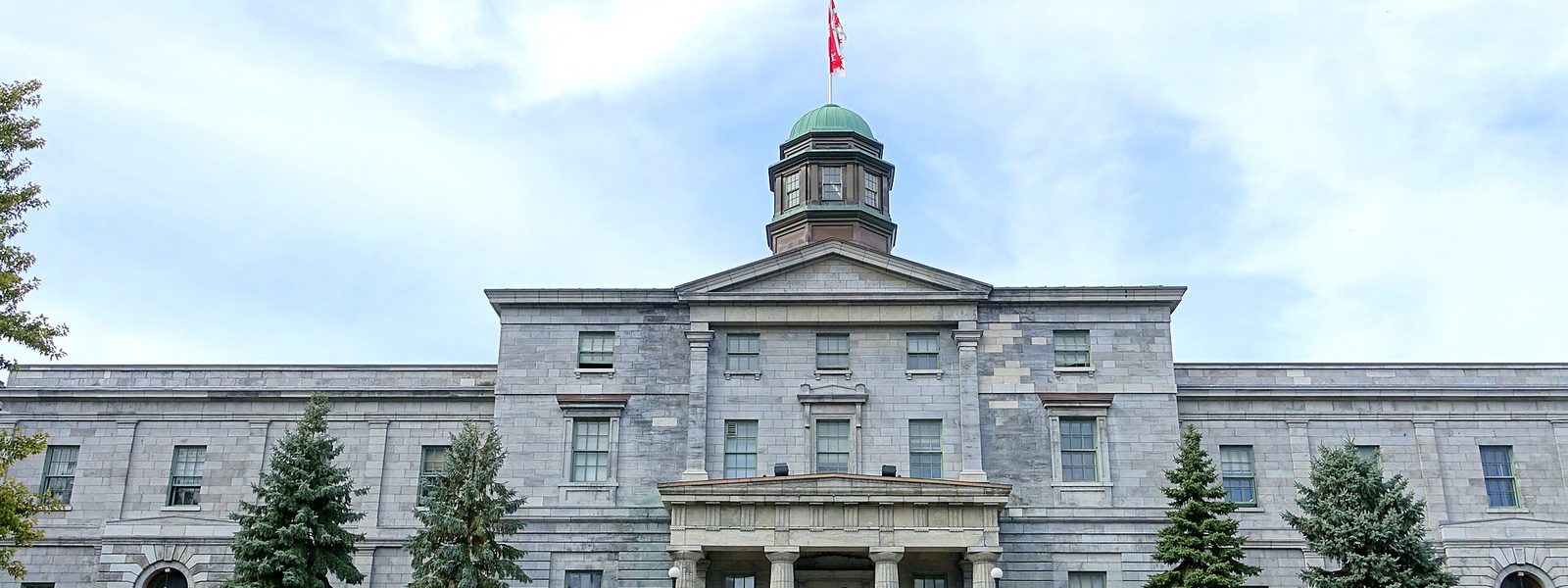
McGill has a long history with the French baccalaureate and says so on its admissions page. It publishes, faculty by faculty, the subjects it requires and the grades out of 20 it usually admits. For a French family, the surprise tends to be the price: a French citizen pays less tuition at McGill than a Canadian from Ontario or British Columbia.
French citizens pay "Rate B"
From autumn 2024, Quebec raised tuition for Canadian students from outside the province, so McGill now has several fee columns depending on the year of admission. French citizens who hold a CAQ (the Quebec acceptance certificate every foreign student needs) stay on "Rate B", the rate for Canadians admitted before 2024. For 30 credits in 2026-2027, tuition at that rate is CAD 9,730.50, in science and in commerce alike.
Compulsory fees come on top: student society, student services, administration, IT and copyright charges. For a Bachelor of Science, McGill shows a total of CAD 12,306.34 at Rate B. A French student on a study permit removes the CAD 195 student health plan and adds CAD 1,151 of international health insurance, which comes to roughly CAD 13,260 for the year before rent and living costs. The rate is not a McGill policy as such; it comes from the agreement between France and Quebec, explained in Studying in Canada after the French baccalaureate.
Two conditions matter. The CAQ and the study permit are applied for after admission, and Rate B only applies with a valid CAQ. Quebec caps the number of CAQs issued to international students; McGill says it has secured its allocation and does not expect admitted students to be refused because of the cap.
Required subjects by faculty
McGill states its prerequisites in terms of the reformed bac's spécialités, the subjects French students choose for première and terminale (the last two years of lycée, Years 12 and 13 in the UK, 11th and 12th grade in the US). For science, engineering, architecture and kinesiology, the rule is the maths spécialité in both years, plus physics-chemistry in première. Arts, education and social work have no subject requirement.
Management is worth reading closely. It accepts two profiles: the maths spécialité through terminale, or the maths spécialité in première followed by the lighter "mathématiques complémentaires" option in terminale. The bar differs. With the full spécialité, McGill's typical maths grades are 15.5 to 16.5; with maths complémentaires, 16.5 to 17. A student who drops the spécialité after première needs about one extra point to compensate.
Programmes on the Macdonald campus in Sainte-Anne-de-Bellevue (agriculture, environment, food science, nutrition) only ask for the maths spécialité in première, with physics-chemistry and one more science subject.
The published grade ranges
McGill publishes "typical minimum admission grade ranges" out of 20, warning that they move every year and guarantee nothing. Their main use is to show how far apart the programmes are.
| Programme | Overall average | Maths and science |
|---|---|---|
| Mechanical engineering, bioengineering | 18 to 19 | 17.5 to 18.5 |
| Architecture | 17.5 to 18.7 | 16 to 18 |
| Civil, chemical, electrical, computer engineering | 17 to 18 | 17 to 18 |
| Physical, Earth, maths and computer sciences | 16.5 to 17.5 | 15.5 to 16.5 |
| Arts | 16.5 to 17.5 | n/a |
| Bachelor of Arts and Science | 16 to 17 | 15 to 16 |
| Materials, mining engineering | 14.5 to 15.5 | 14.5 to 15.5 |
| Kinesiology | 13 to 13.5 | 13 to 13.5 |
| Agriculture and environment (Macdonald) | 11 to 12 | 11 in each |
French grades run lower than most systems: a 16 out of 20 is a very good result, and 18 is rare. Even so, "McGill" on its own means little, since mechanical and mining engineering are more than three points apart. And the grades are read against the class average. McGill says it reviews everything on the bulletins (the French term reports, which show each class average) and expects results above the class average, at least for competitive programmes. A 16 in a class averaging 15 does not read like a 16 in a class averaging 11.
Lines families tend to miss
A few sentences on McGill's page can change a plan.
Prépa does not count. A student who spends a year in a French classe préparatoire before applying is assessed on the bac alone and should apply as a high school applicant, not as a transfer.
An incomplete file can be cancelled. McGill says that when space is limited, preference may go to applicants who sent their documents earlier, and that a programme filling up before the documents deadline may cancel incomplete applications. Decisions for high schools outside North America run from mid-November to mid-May, so a file completed in December is read earlier.
French is not required for admission, with exceptions: nursing asks for proof of French, and dietetics is only open to French bac students from Collège Marie de France and Collège Stanislas, two French lycées in Montreal.
First-year residence is guaranteed for students aged 22 or under who have accepted their offer, provided they apply in spring and confirm the room by mid-June. A student who holds back on McGill while waiting for a British or American answer should keep that date in view.
Example: the timeline for autumn 2027 entry.
Applications open on 1 October 2026. Deadlines: application on 15 January 2027, Major Entrance Scholarship on 21 January, supporting documents on 1 March 2027 (7 March for social work). Decisions estimated from mid-November 2026 to mid-May 2027. Confirmation deposit of CAD 1,000 for international students, forfeited if the student does not register. Residence applications from March 2027. Fees: McGill Student Accounts, 2026-2027 tables.
Who McGill suits
McGill rewards consistency. Most programmes have no essay, interview or test (the application itself is covered in McGill and Canadian universities: is there an essay). Everything rests on the première reports and the first term of terminale, read against the class. For a student averaging 17 with strong maths, engineering or science is realistic, at a fraction of the cost of an American university. A student whose strengths lie outside grades will be better served by an application to the United States or the UK.
So the work starts early: choosing spécialités at the end of seconde (Year 11, 10th grade) with the target programme in mind, holding maths grades through première, and sending a complete file by December. That is what we do with families at Carmine, alongside Parcoursup and the other applications. To talk it through, get in touch, or see our admissions support.