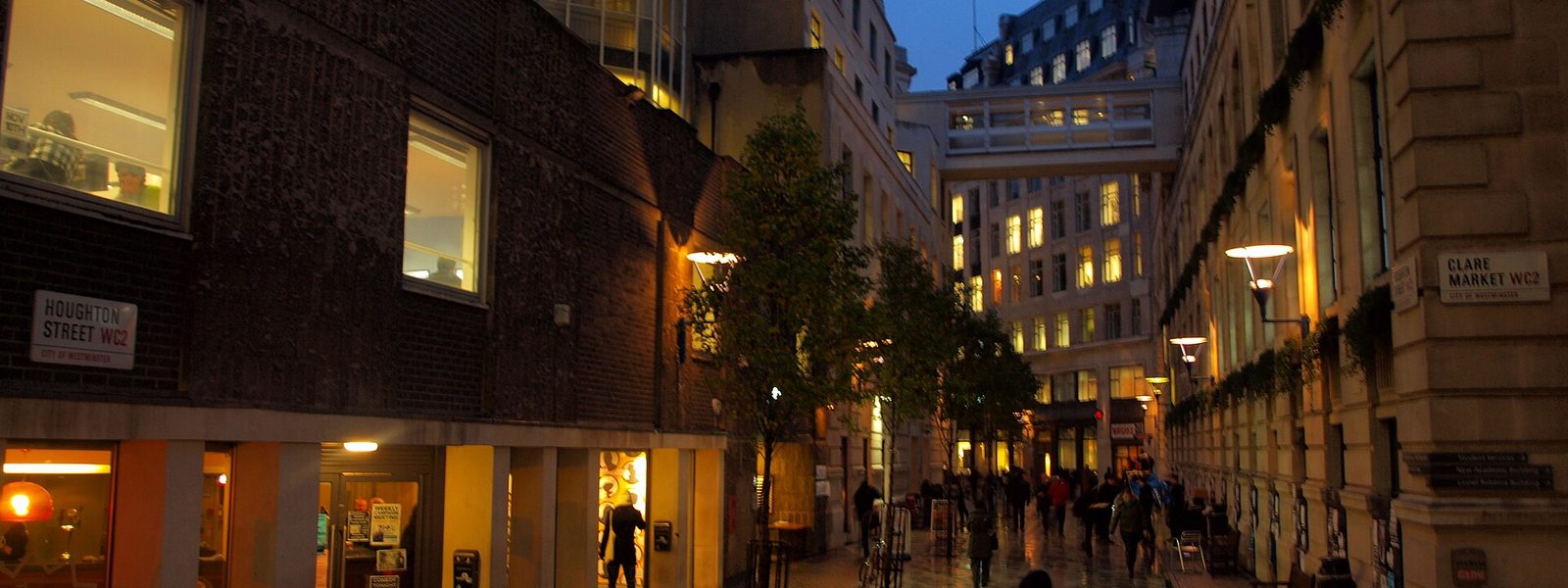
The LSE states on its entry requirements page that it received around 34,000 applications for roughly 1,900 places for 2026 entry. UCL, in Bloomsbury, admits far more students but asks for comparable grades in its most popular courses. For a student finishing the French baccalaureate who wants to study in London, they are two neighbouring doors that work very differently.
Applications go through UCAS, which I describe in UCAS with the French baccalaureate. This article covers what is specific to the two schools: how they convert their requirements into French grades, how selective each programme really is, which tests they use, and what a year in London costs.
What a French bac average is worth at LSE and UCL
French grades run out of 20. A 16 overall earns the mention très bien, the top honours band, and only a minority of candidates reach it. Both schools publish a conversion between A levels and the bac, and they do not say the same thing.
| A level requirement | LSE, French bac | LSE, BFI | UCL, French bac | UCL, BFI |
|---|---|---|---|---|
| A*A*A | not used | not used | 16.5 | 15.75 |
| A*AA | 16 (mention très bien) | 15 | 15.75 | 15 |
| AAA | 16 (mention très bien) | 15 | 15 | 15 |
| AAB | 15 (mention bien) | 14 | 14 | 13 |
| A* in a subject | 16 in the spécialité | 16 in the final exam | ||
| A in a subject | 15 in the spécialité | 15 in the final exam | ||
The BFI is the bilingual Baccalauréat Français International taken in international sections; spécialités are the two major subjects of the final year. The LSE sets the bar at 16 for almost all its programmes, whether they ask English students for A*AA or AAA, so for a French applicant the difference between programmes comes down to competition. UCL grades its conversion in quarter points. The LSE accepts the maths expertes option, an additional final-year maths course, as the equivalent of Further Mathematics, and waives the English test for BFI students who followed the bilingual English route. At UCL, when a course requires maths, the maths spécialité must have been studied over both Year 12 and Year 13.
LSE acceptance rates differ sharply by programme
Every LSE programme page shows the previous year's applications and intake. Those two numbers are enough to gauge the pressure.
Two remarks. The ratio compares applications with enrolments, not with offers; since some admitted students go elsewhere, the real offer rate is higher than the chart suggests. And the very small programmes, PPE with 49 places or Data Science with 20, are harder to enter than Economics, the school's best-known name. A student with strong maths who is torn between PPE and Economics at the LSE should look at these numbers before choosing.
I found no equivalent figures on UCL's course pages. Its requirements place the courses, though: A*A*A for Mathematics, Mathematics with Economics and Computer Science; A*AA for Economics, Law, PPE and Management Science; AAA for History; AAB for Architecture.
The TMUA for economics, and a few surprises
At the LSE the TMUA is compulsory for two programmes, Economics and Econometrics and Mathematical Economics. It is recommended but not required for Mathematics and Economics, Financial Mathematics and Statistics, Data Science, Actuarial Science and the other maths-heavy programmes, where a good score makes an application more competitive. The LSE accepts either the October or the January sitting, while advising October.
UCL requires the TMUA for its BSc Economics from the 2027 cycle. For Computer Science it asks for the TARA, a reasoning test covered in Oxford's TSA and TARA; for Law, the LNAT. In Mathematics, on the other hand, UCL asks for no test at all, and even offers a reduced A level offer combined with a STEP grade. Maths applicants on The Student Room confirm it: their UCL offers arrived weeks before Imperial's, without a TMUA.
For a student strong in maths who wants economics in London, the arithmetic is simple. One TMUA, sat in October, serves the LSE, UCL and Imperial's Economics, Finance and Data Science programme. Content and preparation are in TMUA preparation from a French lycée.
The cost of a year in London
A French student without UK resident status pays the international fee. The LSE has one welcome feature: its overseas fee stays the same for the whole programme. That alone makes an economics degree at the LSE cheaper than St Andrews, where a degree lasts four years and fees rise every year; the full calculation is in Study in the UK with a French baccalaureate.
| Item | LSE | UCL |
|---|---|---|
| Tuition, 2027 entry | £41,900 a year (Economics), fixed for the length of the programme | £40,800 for Economics and PPE, £44,400 for Mathematics, £48,600 for Computer Science, £36,800 for Law, £33,300 for History |
| First-year housing | LSE halls, for example Rosebery Hall in Islington, £200 to £310 a week on a 38-week contract, or Butler's Wharf near Tower Bridge, £153 to £328 over 41 weeks | Accommodation guaranteed in 2026-27 to every first-year undergraduate who applies individually and on time |
| Student visa | £558, plus a £776 health surcharge per year of visa | |
The LSE has no enclosed campus: its halls are spread across London, 1.6 km from Houghton Street for Rosebery Hall and over 3 km for Butler's Wharf. Contracts cover the academic year only, so summer needs a plan. Families used to boarding schools or American campuses are often caught out by this.
Example: the cycle for entry in 2027.
UCAS application by 13 January 2027 at 6 pm UK time, the equal consideration date for both the LSE and UCL. TMUA from 12 to 16 October 2026, or from 4 to 8 January 2027 for the winter sitting, with booking open from 26 October to 21 December 2026. A student who also applies to Oxford or Cambridge sends the whole application, LSE and UCL included, by 15 October 2026.
What about Warwick and King's?
Comparing conversion tables is revealing. For the same A*A*A requirement, UCL and Oxford ask for 16.5 in the bac; Warwick and Imperial's mathematics department ask for 17. For an A* in a subject, the LSE, UCL and Oxford ask for 16 in the spécialité, Warwick for 17, and even 18 in maths for its two mathematics degrees. A student averaging 16 with 17 in maths therefore meets the LSE and UCL conversions and falls just short at Warwick, which is not necessarily the easiest choice on the list.
King's College, on the Strand next to the LSE, is the other London university I look at for law or international relations. I have not reproduced its conversion table here; as everywhere, it has to be checked course by course.
LSE or UCL: how I tell them apart
The LSE is a social science school, small by London standards, where everything revolves around economics, finance, law and politics. UCL is a full university, from medicine to architecture, where economics is one department among many. A student who knows they want economics and finance will find at the LSE a concentration few schools offer. A student who wants to keep bridges open, or whose interests cross disciplines, will be more at home at UCL.
For very quantitative profiles, Imperial belongs in the comparison. On The Student Room, a former student describes turning down the LSE and UCL for Imperial's Economics, Finance and Data Science programme, with no regrets. My advice is narrower: when the student is strong in maths, put all three on the table. The choice of spécialités, the personal statement, covered in the UCAS personal statement for French students, and the admissions test all follow from it.
At Carmine we help families make these choices and build the application: the five UCAS choices, consistency between spécialités and courses, TMUA preparation, the personal statement, then choosing between offers in the spring. Our admissions support is described on its own page, and you can reach us through the contact page.